Message
All templatesIndustry-Specific
CPG Shelf Impact Study: Pack Findability & Claim Evaluation
Measures on-shelf findability, visual distinctiveness, and claim clarity of CPG packaging using a simulated shelf scenario. Designed for shopper panels to produce actionable pack-design diagnostics.
No sign-up to try · Unlimited responses on the free plan
Live preview
CPG Shelf Impact Study: Pack Findability & Claim Evaluation
Welcome! This brief survey ( 13 minutes) asks about your impressions of a product displayed on a simulated store shelf. There are no right or wrong answers—we are interested in your honest opinions based on what you see and your shopping experience. Your responses are confidential, will be reported only in aggregate, and are used for internal research purposes. Participation is voluntary, and you may stop at any time.
Powered by QuestionPunk
Default theme. Colors and fonts are yours to change.
Sample questions
A preview of what’s in the template. Every question is editable before you launch.
26 questions · ~12 min
Q01
Multiple Choice
Which of the following best describes your role in household grocery shopping?
- I am the primary grocery shopper
- I share the grocery shopping responsibility
- Someone else does most of the grocery shopping
Q02
Multiple Choice
Where do you usually buy products in this category? (Select all that apply.)
- Supermarket/grocery store
- Mass retailer (e.g., big-box store)
- Club/warehouse store
- Drugstore/pharmacy
- Convenience store
- Online retailer
- Local/specialty shop
- Other (please specify)
Q03
Opinion Scale
How familiar are you with products in this category?
Scale: 1 – 5
Min:Not at all familiarMax:Extremely familiar
Q04
Dropdown
In the past 3 months, how often have you bought products in this category?
- More than once a week
- About once a week
- 2–3 times per month
- About once a month
- Less often
- Never in the past 3 months
Message
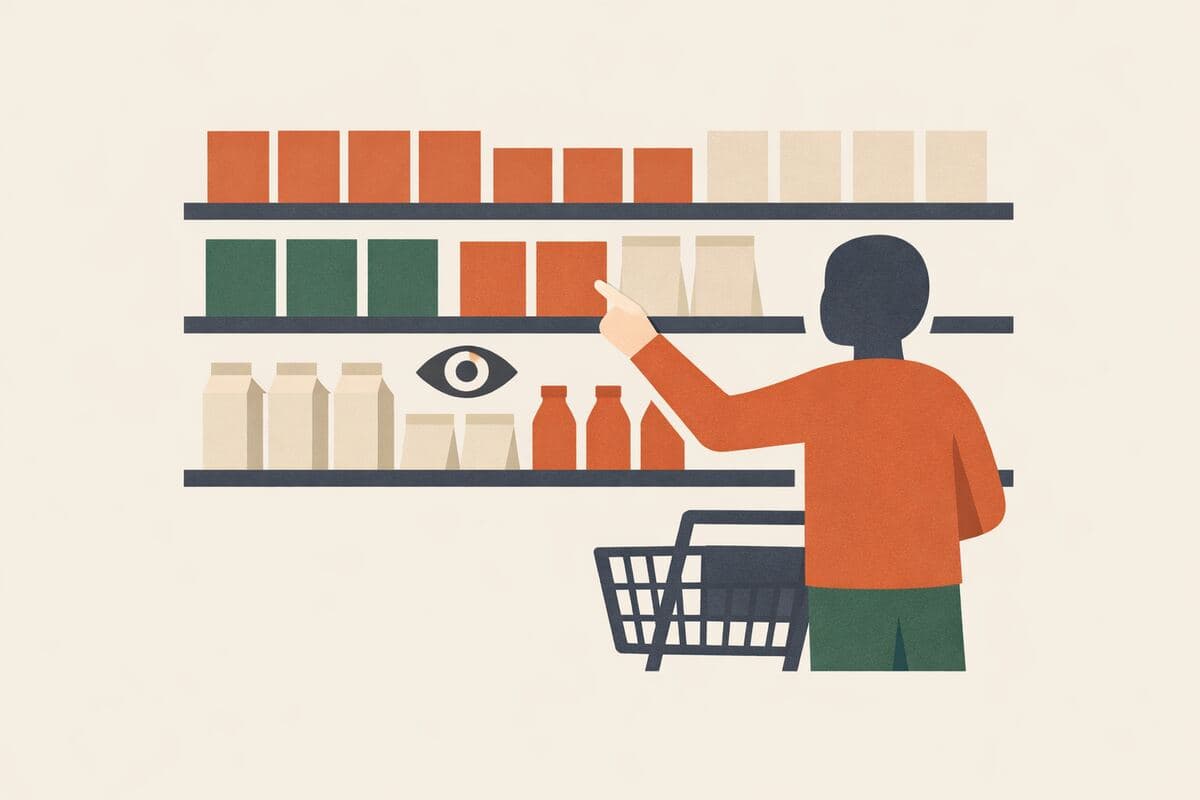
Please take a moment to picture the store shelf where you usually find products like these. Imagine you are browsing this aisle during a typical shopping trip. When you are ready, continue to the next page.
Q05
Multiple Choice
Thinking about the featured product, did you notice it on the shelf?
- Yes, immediately
- Yes, after some scanning
- No, I did not notice it
Q06
Dropdown
Approximately how long did it take you to spot the featured product on the shelf?
- Less than 2 seconds
- 2–5 seconds
- 6–10 seconds
- 11–20 seconds
- More than 20 seconds
- I did not spot it
Q07
Multiple Choice
What, if anything, made it difficult to notice the featured product? (Select all that apply.)
- Nothing—it was easy to spot
- The shelf looked crowded
- Colors blended with nearby products
- Brand name was too small
- Claim or text was not visible
- Shape/format looked similar to others
- I looked in the wrong area
- I am unfamiliar with this pack
- Lighting or contrast seemed low
- Other (please specify)
Q08
Opinion Scale
Overall, how easy or difficult was it to spot the featured product on the shelf?
Scale: 1 – 7
Min:Very difficultMax:Very easy
Q09
Ranking
Please rank the following pack elements in the order you noticed them (drag the first element you noticed to the top).
- Brand name
- Pack colors
- Claim text/badge
- Imagery/icons
- Pack shape/format
- Price/offer tag
Drag to rank
Q10
Opinion Scale
How much did the featured product stand out visually compared with the other products on the shelf?
Scale: 1 – 7
Min:Did not stand out at allMax:Stood out a great deal
Q11
Multiple Choice
If you could change one thing about the pack to improve how easily it is found on the shelf, which would you choose?
- Make brand name larger
- Increase color contrast
- Move claim to top/front of pack
- Clarify claim wording
- Use stronger imagery/icons
- Add a price/offer tag
- Other (please specify)
Q12
Long Text
If you selected 'Other' above, please briefly describe the change you have in mind.
Q13
Long Text
In one sentence, what was the main claim or message you took away from the featured product's pack?
Q14
Opinion Scale
How clear was the main claim displayed on the featured product's pack?
Scale: 1 – 7
Min:Not at all clearMax:Extremely clear
Q15
Opinion Scale
How relevant was the main claim to your needs in this category?
Scale: 1 – 7
Min:Not at all relevantMax:Extremely relevant
Q16
Opinion Scale
How believable or unbelievable did the main claim on the featured product feel to you?
Scale: 1 – 7
Min:Not at all believableMax:Extremely believable
Q17
Multiple Choice
Based on its packaging and position on the shelf, which price tier does the featured product appear to belong to?
- Budget/value
- Mid-range
- Premium
Q18
Opinion Scale
How likely or unlikely are you to consider buying the featured product on your next shopping trip?
Scale: 1 – 7
Min:Very unlikelyMax:Very likely
Q19
Long Text
In a few words, what most made the featured product stand out or blend in on the shelf?
Q20
AI Interview
We would like to explore your shelf experience in a bit more depth. An AI moderator will ask you a couple of brief follow-up questions based on your earlier responses.
Q21
Long Text
Based on your responses in this survey, please share any additional thoughts or comments about the shelf experience or the featured product's pack.
Q22
Dropdown
What is your age?
- 18–24
- 25–34
- 35–44
- 45–54
- 55–64
- 65+
- Prefer not to say
Q23
Multiple Choice
How do you describe your gender?
- Woman
- Man
- Non-binary
- Prefer to self-describe
- Prefer not to say
Q24
Long Text
In which country or region do you currently live?
Q25
Dropdown
What is the highest level of education you have completed?
- Less than high school
- High school diploma/GED
- Some college/Associate degree
- Bachelor's degree
- Postgraduate degree
- Prefer not to say
Q26
Dropdown
What is your current employment status?
- Full-time
- Part-time
- Self-employed
- Homemaker
- Student
- Unemployed and looking
- Not working by choice
- Retired
- Prefer not to say
Message
Thank you for your time! Your feedback helps us understand how packaging performs on the shelf. Your responses have been recorded.
What’s included
AI follow-ups
Adaptive probes on open-ended answers that pull out detail a static form would miss.
Attention checks
Built-in safeguards against rushed answers and low-quality respondents.
AI-drafted copy
Wording, ordering, and branching written by the AI — tuned to your research goal.
Auto report
Themes, quotes, and a plain-English summary write themselves once responses come in.
Frequently asked questions
What questions are in the “CPG Shelf Impact Study: Pack Findability & Claim Evaluation” template?
The template includes 26 ready-to-use questions, starting with: “Which of the following best describes your role in household grocery shopping?” · “Where do you usually buy products in this category? (Select all that apply.)” · “How familiar are you with products in this category?”. The full set is previewed above, and every question is editable.
How long does this survey take to complete?
Respondents typically finish the 26 questions in about 12 minutes.
Can I customize this template?
Yes — every question, answer option, and the ordering is editable before you launch. You can add or remove questions, or ask the AI editor to rework the survey around your research goal.
Is this template free to use?
Yes. Open it in the editor and start customizing right away — no account required to try it, and the free plan covers launching your survey.
Ready to launch?
Open this template in the editor. Every part is yours to change before the first respondent sees it.
Related templates
More studies on similar topics.